How to Write Etsy Titles That Actually Get Found in 2026
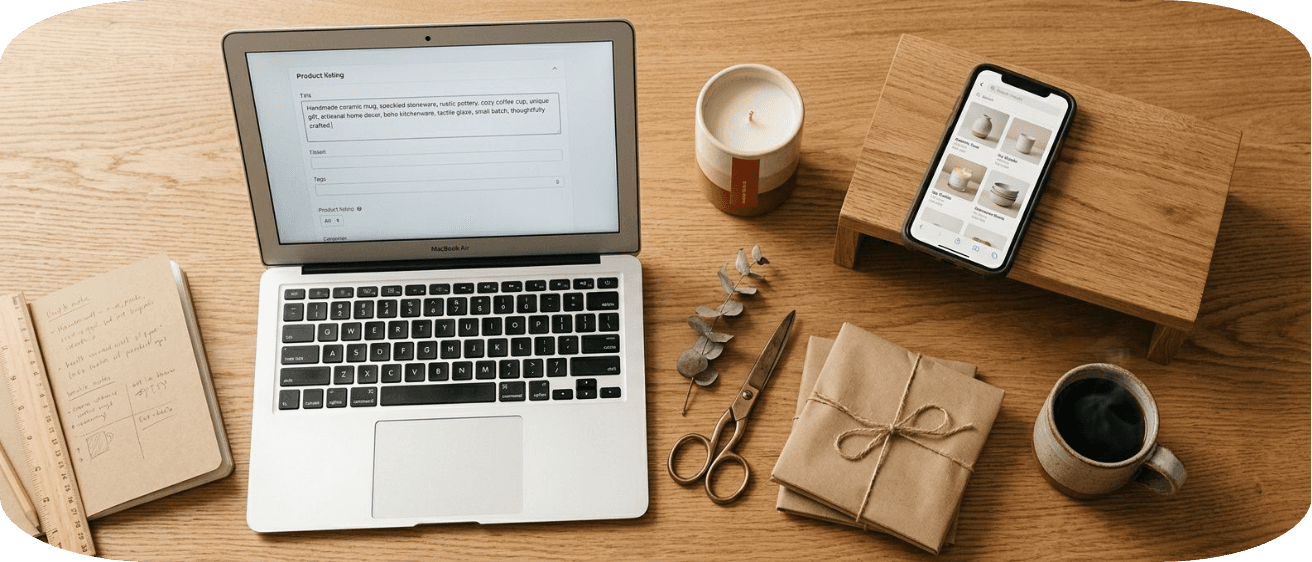
Your Etsy title is doing two jobs at once. It needs to tell Etsy's algorithm what your product is so the right buyers see it, and it needs to make a real human in line at Starbucks tap on your listing instead of the seven other ones around it. Most sellers are doing one or the other. Almost nobody is doing both well.
Learning how to write Etsy titles that rank in 2026 starts with a small mindset shift: stop thinking of the title as a list of keywords and start thinking of it as the most valuable real estate in your shop. You only get 140 characters, and the first 40 of those decide whether you exist on mobile.
This guide covers the rules, a reusable formula, before-and-after examples across handmade and digital products, the punctuation question, and the mistakes that quietly tank rankings.
Key Takeaways
The first 40 characters carry the most weight in Etsy's algorithm and are the only ones visible on mobile previews.
You have 140 characters total. Use them all without repeating yourself.
Commas are now Etsy's recommended separator. Dashes can be ignored or read as negation.
Keyword stuffing was the 2018 playbook. The 2026 algorithm rewards natural, descriptive titles.
Refresh your titles quarterly. Search behavior shifts seasonally and last quarter's winner often slips.
How to Write Etsy Titles: The 60-Second Version
To write Etsy titles that rank in 2026, put your strongest keyword phrase in the first 40 characters, use all 140 characters available, separate phrases with commas, and avoid repeating the same word more than twice. Write so a real shopper would read it naturally, not so a robot scans it.
That's the version you can take with you. The rest of this guide explains why each rule exists and how to apply it without sounding like a search engine.
Why the First 40 Characters Decide Everything
Three things happen in the first 40 to 50 characters of your title, and all three matter.
Mobile truncation. Over 60 percent of Etsy traffic now comes from mobile, and Etsy's mobile search results cut off titles at roughly 40 to 50 characters. If "Hand-Poured Soy Candle" shows up at character 80 of your title, no mobile shopper will ever see it.
Google previews. When your listing surfaces in Google search results, only the first 50 to 60 characters typically display in the link. A buyer scanning Google results decides whether to click in less than two seconds, and they're judging whatever shows up in that preview.
Algorithm weighting. Etsy has confirmed that the algorithm gives more weight to keywords appearing earlier in your title. A perfect-match phrase at character 5 outranks the same phrase at character 95.
The practical rule: whatever your single most important keyword phrase is, that phrase needs to be intact and inside the first 40 characters. No exceptions. If you want the bigger picture on what Etsy actually rewards, here's how Etsy's algorithm works in 2026.
The 140-Character Rule (and How to Use Every One)
Etsy gives you exactly 140 characters for your listing title, including spaces and punctuation. Most sellers use 60 to 90 and leave the rest empty. That's a missed opportunity.
The 140-character ceiling is intentionally generous because Etsy wants you to cover multiple search variations. Buyers don't search the same phrase twice. One person searches "boho candle holder," another searches "rustic candle holder for living room," another searches "macrame candle holder gift for mom." A well-written title can capture all three without sounding like spam.
The trick is variety, not repetition. If "candle holder" appears once in your title, that's enough for the algorithm to know your product is a candle holder. Repeating "candle holder" four times doesn't quadruple your ranking. It just wastes characters and trips Etsy's keyword-stuffing detection. For Etsy's own take on this, see the Etsy Seller Handbook's guidance on listing titles.
A Reusable Etsy Title Formula
There's no single formula that works for every category, but the structure most top sellers use looks like this:
[Primary Keyword Phrase], [Style or Material Modifier], [Use Case or Audience], [Occasion or Gift Modifier]
Each section is separated by a comma. Each section captures a different way buyers search.
Applied to a handmade product:
"Personalized Cutting Board, Engraved Walnut Charcuterie Board, Housewarming Gift for Couples, Custom Wedding Anniversary Present"
That's 132 characters. The primary keyword (Personalized Cutting Board) lives in the first 30 characters. The next chunks pick up "engraved walnut charcuterie board" (a different search), "housewarming gift for couples" (gift intent), and "wedding anniversary present" (occasion intent).
For a digital product, the formula shifts slightly:
[Primary Keyword], [Style or Theme], [File Type and Delivery], [Specs]
"Wedding Seating Chart Template, Minimalist Greenery Design, Editable Canva Template, Instant Download, A4 and US Letter"
That's 121 characters and covers four distinct ways a bride might search.
Real Etsy Title Examples (Before and After)
Examples make this click faster than any rule.
Before: Mug Coffee Mug Cup Funny Cat Mug Gift For Her Cat Lover Mug
That title repeats "mug" four times, "cat" twice, and reads like a search engine wrote it. It's also only 60 characters, leaving 80 unused.
After: Funny Black Cat Coffee Mug, Cat Lover Gift for Her, Whimsical Ceramic Mug, Birthday Gift for Cat Mom, 11oz
That's 109 characters. "Coffee mug" appears once, "cat" appears across distinct phrases, and three different gift contexts (for her, birthday, cat mom) capture three different searches.
Before: T-Shirt Women Shirt Plant Shirt Monstera Tee Botanical Top Gift
After: Monstera Leaf T-Shirt, Plant Lover Gift for Her, Botanical Graphic Tee, Minimalist Plant Shirt, Cottagecore Top
That's 113 characters and reads like something a human would actually search for.
Before: Handmade Notebook - Vintage Leather Journal - Personalized Diary
After: Personalized Leather Journal, Handmade Vintage Notebook, Custom Travel Diary, Gift for Writers, Refillable Journal
The "after" version replaces dashes (which Etsy now suggests against) with commas, front-loads the personalization angle, and adds gift and use-case modifiers.
Commas, Pipes, Hyphens: How to Punctuate Your Title
Etsy's official guidance has shifted in the last year. As of April 2026, commas are the recommended separator. Dashes can be interpreted as negation by some search engines and have been deprioritized by Etsy itself. Pipes (|) are still readable but less common.
Three practical rules:
Use a comma between every distinct phrase. "Boho Throw Pillow, Living Room Decor" reads as two phrases, not one long phrase.
Always put a space after the comma. Etsy's parser recognizes phrases by spacing, so "pillow,decor" can confuse it where "pillow, decor" doesn't.
Don't open or close with punctuation. Start and end with a keyword.
Strictly speaking, you don't need any punctuation for the algorithm to read your title. Etsy looks for keyword phrases either way. But buyers do read it, and a comma-separated title is easier to scan than a wall of words.
Mistakes That Tank Your Rankings
A few patterns reliably hurt Etsy listings, often without the seller realizing why traffic dropped.
Repeating the same keyword three or more times. Etsy's algorithm has gotten aggressive about flagging this. If "earrings" appears five times in your title, expect a quiet ranking penalty.
Filler adjectives in valuable positions. "Beautiful," "stunning," "amazing," and "unique" don't get searched. Putting them in the first 40 characters wastes prime real estate.
Brand or shop name in the title. "The Olive Branch Co. Boho Wall Art" buries the searchable phrase. Save your shop name for the description.
Identical titles across listings. Etsy reads near-duplicate titles as low-effort and tends to consolidate ranking onto one of them, hiding the rest. Each variation of a product needs its own title.
Stuffing every tag word into the title. Tags and titles are different fields with different roles. A title is for humans plus algorithm. A tag is for the algorithm only.
These often overlap with broader Etsy listing mistakes that cost sellers sales. If you want a quick automated check, ListingView's listing audit tool flags these patterns and scores your title against best practices. You can also do this manually by reading your title out loud. If you sound like a robot, the algorithm thinks you sound like a robot.
How to Find the Right Keywords to Put in Your Title
A perfectly structured title is useless if you're targeting phrases nobody searches for. Three free ways to find keywords your buyers actually use:
Etsy's search bar autocomplete. Start typing a phrase related to your product and watch what Etsy suggests. Those suggestions are pulled from real shopper searches.
Top sellers in your subcategory. Open the listings ranking on page one for your target keyword and study the patterns in their titles. Don't copy them. Identify the modifiers you're missing.
Etsy's category browse pages. Sub-subcategories on Etsy reveal the language buyers use to filter products. "Personalized" vs "Custom" vs "Monogrammed" all describe similar things, and shoppers cluster around different words. Etsy also publishes an official Keywords 101 guide that's worth reading before you start.
For a deeper data view, ListingView's search term analyzer shows real search volume and competition for any phrase, which is helpful when two candidate keywords look equally good and you need to break the tie. You can also pair this with broader product research on Etsy to make sure you're targeting a phrase with real demand behind it.
How to Test and Improve Your Titles Over Time
Title optimization isn't a one-and-done task. Search behavior shifts seasonally, competitors update their listings, and what ranked in Q1 often slips by Q3. A reasonable rhythm:
Quarterly: review your top 10 best-selling listings and refresh titles that are underperforming relative to traffic.
Before seasonal peaks: update gift-relevant phrases. "Mother's Day gift" pulls hard in April. "Stocking stuffer" pulls in November.
When traffic drops: don't panic-rewrite. Check whether tags, photos, or shipping changed first. Rewriting a title before diagnosing the issue can lose the ranking you had.
When you do rewrite, change one variable at a time and give it at least two weeks before judging the result. Etsy search rankings have a rolling window, and immediate post-edit data is rarely a fair test. For a structured walkthrough of optimizing an existing listing, Etsy's titles, descriptions, and tags makeover guide is the single best free resource.
Frequently Asked Questions
How long should an Etsy title be?
Etsy gives you 140 characters and you should use most or all of them. Aim for 130 to 140 characters with your strongest keyword phrase intact within the first 40. Titles shorter than 90 characters typically leave ranking opportunities on the table by missing the search variations buyers actually use, and the unused characters are essentially free advertising.
What are the first 40 characters of an Etsy title?
The first 40 characters of an Etsy title are the only portion fully visible on mobile search results, where over 60 percent of Etsy traffic comes from. Etsy's algorithm also weights keywords in this section more heavily. Your strongest keyword phrase needs to appear intact within those 40 characters or most buyers will never see it.
Should I use commas in Etsy titles?
Yes. As of 2026, Etsy officially recommends commas as the separator between phrases in your title. Buyer testing showed commas are the most readable option. Dashes can be interpreted negatively by some search algorithms and pipes are less common. Always include a space after each comma so Etsy's parser reads each phrase cleanly.
Does keyword stuffing still work on Etsy?
No. Etsy's algorithm now actively flags excessive keyword repetition and applies ranking penalties. Repeating "candle" five times in a title was standard practice in 2018 but reliably hurts rankings in 2026. Use each keyword once and capture variations through different phrases (e.g., "soy candle, lavender scent, hand-poured" rather than "candle candle candle").
How often should I update my Etsy titles?
Refresh your titles quarterly at minimum. Etsy search behavior shifts seasonally, and keywords that performed well in Q1 may weaken in Q3. Also update titles ahead of seasonal peaks (Mother's Day in April, stocking stuffers in November) and review your top 10 listings whenever traffic drops noticeably to catch any algorithm shifts.
Our team is consistently improving ListingView to provide better data, tools, and insights for Etsy sellers. Because of this, some features or screenshots mentioned in this post may look slightly different from what you see inside ListingView.