Etsy Tags Best Practices in 2026: The Full Playbook
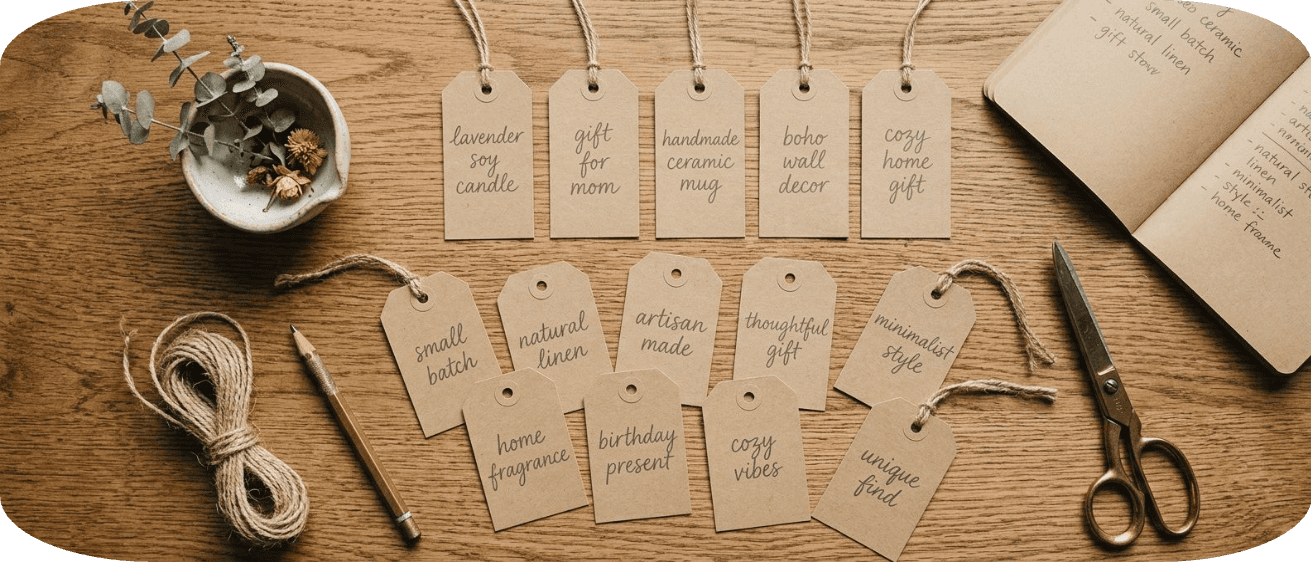
Tags are the most underused field on Etsy. Sellers obsess over titles and ignore tags, then wonder why their listings flatline at 30 views a month. The truth is that tags do half the work of getting your product in front of the right buyer, and most shops are running with five or six tags filled out with single words like "candle" and "gift."
Etsy tags best practices in 2026 aren't complicated, but they have shifted. Etsy's algorithm has gotten smarter about matching phrases, plurals, and synonyms, which means the old tactic of stuffing in every variation of a word is actively wasting tag slots that could be capturing entirely different searches.
This guide covers how tags actually work, the 13-tag and 20-character rules, a step-by-step way to build your 13 tags from scratch, and the mistakes that quietly kill rankings.
Key Takeaways
Etsy gives you 13 tag slots and 20 characters per tag. Use all 13.
Multi-word phrases (3 to 5 words) consistently beat single words.
Don't repeat the same keyword across tags. Etsy doesn't stack the ranking.
Skip plurals and misspellings. Etsy's algorithm handles both automatically.
Tags and titles cover different searches. Don't duplicate, complement.
Etsy Tags Best Practices: The 60-Second Version
Etsy tags best practices for 2026 come down to five rules: use all 13 tag slots, fill them with 2-to-5-word phrases instead of single words, don't repeat the same keyword across tags, skip plurals and misspellings (Etsy handles those automatically), and refresh tags quarterly when search behavior shifts.
That's the version you can take with you. The rest of this guide explains why each rule matters and walks through building 13 tags from scratch.
How Etsy Tags Actually Work (and How They're Different From Titles)
A tag is a search keyword phrase that helps Etsy match your listing to a shopper's query. You get 13 of them, and they sit behind the scenes (buyers never see them). Etsy's algorithm scans both your title and your tags to decide whether to show your listing for a given search.
The critical thing to understand is that tags and titles are not interchangeable. Your title needs to read naturally for humans because shoppers see it. Your tags don't, because they're invisible. That means tags are the place to capture all the awkward, specific, long-tail phrases that would never fit gracefully into a title.
Etsy's algorithm checks for two types of match: exact match (your tag contains the exact phrase the shopper searched) and broad match (your tag contains some of the search words but not in the exact order). Exact match ranks meaningfully higher, which is why writing tags as complete phrases matters so much.
If you want the full picture on how Etsy decides what to surface, here's how Etsy's algorithm actually works in 2026.
The 13-Tag, 20-Character Rules (and What They Mean)
Etsy's rules for tags are simple but specific:
You get 13 tags per listing.
Each tag can be up to 20 characters, including spaces and punctuation.
Tags can contain multiple words inside a single tag. "Cozy coffee mug" (15 characters) is one tag, not three.
Single words and phrases are both allowed, but multi-word phrases match more specific searches.
You can use letters, numbers, and a small set of characters. Avoid commas, semicolons, and pipe symbols inside a tag (they don't help with matching).
The 20-character ceiling sounds tight until you realize what fits. "Personalized gift" is 17 characters. "Coffee lover gift" is 17. "Boho wall decor" is 15. The limit is generous enough for almost every long-tail phrase you'd actually want to target. For the official Etsy reference, see Etsy's help article on tags.
Use All 13 Slots, and Use Them on Phrases
The single biggest tag mistake is leaving slots empty. If you fill 7 tags and skip 6, you're forfeiting 6 chances to match a search a buyer is actively typing.
The second biggest mistake is filling those slots with single words.
A tag like "candle" is technically valid, but it competes against several million other listings that also tagged "candle." A tag like "lavender soy candle" (19 characters) competes against a fraction of that, and the people searching that exact phrase are much closer to buying.
Here's what 13 well-built tags look like for a 9oz hand-poured soy candle:
lavender soy candle
hand poured candle
relaxation gift
gift for mom
soy wax candle
natural candle
self care gift
housewarming gift
small batch candle
scented soy candle
minimalist decor
eco friendly gift
apartment warming
Every tag is a multi-word phrase. Every tag targets a different search a real shopper might type. No tag repeats the same word pairing.
Compare that to a typical underbuilt tag set:
candle
candles
soy candle
soy candles
lavender
gift
handmade
natural
small
(empty)
(empty)
(empty)
(empty)
That set wastes slots on singular vs. plural duplicates, single-word tags that face huge competition, and four blank slots. The first set will outrank the second set on every long-tail phrase that matters.
Don't Repeat the Same Keyword Across Tags
Repeating a word across tags doesn't stack your ranking power. If "candle" appears in six different tags, Etsy doesn't rank you six times harder for "candle." It mostly just burns tag slots that could be matching other searches.
A few common repetition patterns to avoid:
Singular and plural of the same word. "Cat mug" and "cat mugs" are not two tags. They're one tag with a wasted slot. Etsy handles plurals automatically, which we'll cover next.
Same words in different order. "Cat mom" and "mom cat" match the same searches. Pick one.
Same word with a generic modifier. "Soy candle" and "small soy candle" target nearly identical search behavior. Use one and put "small batch" or "9oz" in a different tag.
Stuffing your most important keyword into multiple slots. If "personalized necklace" is your hero phrase, use it once. Use the other 12 slots for adjacent searches.
The rule of thumb: each tag should capture a meaningfully different search. If you can't explain how Tag 4 captures something different from Tag 7, one of them is wasted.
Plurals, Misspellings, and Regional Spellings: What Etsy Handles for You
Etsy's algorithm has gotten significantly smarter about word variation. There are three things you specifically do not need to waste tag slots on:
Plurals. Etsy matches root words. A search for "diaries" returns listings tagged "diary." A tag for "earring" also matches "earrings." Pick one form and move on.
Misspellings. When shoppers misspell common search terms, Etsy redirects them to the correct results. A shopper who types "bracelt" gets routed to "bracelet" listings. You don't need a "bracelt" tag.
Capitalization. Etsy is case-insensitive on tags. "Coffee Mug," "coffee mug," and "COFFEE MUG" all match the same searches.
Three things Etsy does NOT automatically handle, which you should consciously include:
Regional spellings. If your buyer is in the UK, they search "jewellery," not "jewelry." Etsy can match across regional spellings in some cases, but if your audience is regional, include the regional form explicitly.
Synonyms. "Sandals" and "thong sandals" are not the same word. "Couch" and "sofa" are not the same word. Use tag slots for synonyms your buyers actually use. Etsy's Keywords 101 guide gives examples of when synonyms matter.
Slang and informal terms. Buyers searching for a "puppers" mug for their dog-mom friend won't find your "puppy mug" listing on the first pass.
How to Build Your 13 Tags From Scratch (Step-by-Step)
Here's a process that works for any new listing. Plan on 20 minutes per product the first time, less once you have the rhythm.
Step 1: Write down your hero phrase. This is the 2-to-4-word phrase that best describes your product. For a hand-painted ceramic mug, it might be "hand painted ceramic mug." Write it as Tag 1.
Step 2: Brainstorm 3 to 5 product variations. What else could a shopper call this? Material variants, style variants, scale variants. "Stoneware mug," "artisan coffee mug," "speckled ceramic mug." These become Tags 2 through 5.
Step 3: Add 3 gift-context tags. Who is this product bought for? "Gift for coffee lover," "housewarming gift," "gift for mom." Use real recipient and occasion language.
Step 4: Add 2 to 3 use-case or aesthetic tags. How does the buyer use the product, or what aesthetic does it fit? "Cozy kitchen decor," "minimalist mug," "morning ritual."
Step 5: Add 2 final long-tail tags. Look at the buyer's specific language. "Mug for tea lover," "wedding gift idea," "bridesmaid gift box."
Step 6: Sanity-check the list. Read all 13 out loud. If any two sound like the same search, replace one. If any tag is a single word, can you make it a phrase under 20 characters? If yes, do that.
The whole process gets faster as you reuse "tag families" across similar products. A pottery shop can reuse 4 to 5 tags across an entire collection and swap in 8 to 9 unique ones per piece.
You can also pair this manual process with broader product research on Etsy to see what phrases the bestsellers in your niche are actually targeting.
Tag Mistakes That Quietly Kill Rankings
Some patterns reliably hurt listings without obvious feedback. If your traffic is lower than your title and photos suggest it should be, check for these:
Empty tag slots. Already covered, but the most common issue. Open every listing in your shop and count.
Single-word tags. "Gift," "candle," "necklace" alone almost never rank competitively. Always upgrade to a phrase.
Misspellings on purpose. Don't tag "diamint ring" hoping to catch typos. You'll just look unprofessional in your shop dashboard and Etsy auto-corrects buyer typos anyway.
Promotional language. "Sale," "discount," "best price," and "fast shipping" aren't searched the way you think they are. Skip them.
Brand or shop name in tags. Save your shop name for your shop, not your tags. Buyers don't search for your shop name from the main search bar.
Duplicate tags across all your listings. If every listing in your shop has the same 13 tags, Etsy may flag your shop as low-effort or consolidate ranking. Vary tags by product.
Tags that contradict your title. If your title says "Christmas," don't tag "Easter." Don't tag aspirationally across categories.
These often overlap with broader Etsy listing mistakes that hurt sales.
For a structured audit, ListingView's Tag Analyzer flags repetition, low-volume tags, and missed phrase opportunities. You can also do this manually by exporting your listings to a spreadsheet and scanning for word repeats column-by-column.
How to Audit and Refresh Your Tags
Tags are not a set-and-forget field. Search behavior shifts seasonally, new modifiers gain popularity, and last quarter's top phrase often loses ground to a new long-tail variant.
A reasonable cadence:
Monthly: open Shop Stats and look at the search terms driving traffic to your top 10 listings. Phrases that appear in your stats but not your tags are quick wins.
Quarterly: rebuild tags on your bottom 10 percent of listings. If something has been at 20 views for three months, the tags are not working.
Before seasonal peaks: add gift-relevant tags. "Mother's Day gift" pulls hard in April. "Valentine gift for him" pulls in early February. "Stocking stuffer" pulls from October to December.
After a traffic drop: before you panic-rewrite, check whether tags drifted or whether something else changed (photo update, shipping change, photo policy violation). Tags are usually the third thing to suspect, not the first.
When you do refresh, change one variable at a time and give it at least two weeks. Etsy search ranking has a rolling window, and immediate post-edit numbers are rarely a fair test. As of April 2026, sellers report ranking shifts taking 7 to 14 days to stabilize after tag changes. For a structured walkthrough of refreshing tags alongside titles and descriptions, Etsy's listing makeover guide is the single best free resource.
Frequently Asked Questions
How many tags can you have on Etsy?
Etsy allows up to 13 tags per listing, with a 20-character limit on each tag including spaces. You should use all 13 slots. Every empty tag is a forfeit search match. Multi-word phrases (3 to 5 words) consistently outperform single words because they match specific shopper queries with less competition.
Should Etsy tags match the title?
No. Tags and titles should complement each other, not duplicate. Your title captures your primary keyword and the main phrases buyers see in search. Tags should pick up the long-tail variations, synonyms, gift contexts, and use-case phrases that don't fit naturally into a title. Etsy's algorithm scans both fields, so coverage is what matters, not repetition.
Do I need to use plurals in Etsy tags?
No. Etsy's algorithm uses root word matching, so a tag for "necklace" automatically matches searches for "necklaces" and vice versa. The same applies to "diary" vs "diaries" or "mug" vs "mugs." Using a plural variant in a separate tag wastes a slot you could spend on a different long-tail phrase.
What is a good Etsy tag?
A good Etsy tag is a 2-to-5-word phrase, between 10 and 20 characters, that matches how a real shopper would search for your product. Examples: "lavender soy candle" (19 chars), "gift for coffee lover" (caution, 21 chars, too long), "housewarming gift" (17 chars), "minimalist wall art" (19 chars). Phrases beat single words almost every time.
How often should I update my Etsy tags?
Audit tags monthly using Shop Stats data, and do a deeper refresh quarterly on any listing that's underperforming relative to traffic. Update gift-relevant tags ahead of seasonal peaks (Mother's Day in April, holidays in October to December). When you do change tags, modify one variable at a time and give the change 7 to 14 days before judging results.
Our team is consistently improving ListingView to provide better data, tools, and insights for Etsy sellers. Because of this, some features or screenshots mentioned in this post may look slightly different from what you see inside ListingView.