How to Price Products on Etsy in 2026 (Without Losing Money)

Pricing is the scariest part of selling on Etsy. Set it too low and you work for free. Set it too high and your listings collect dust. Learning how to price products on Etsy well is less about a secret formula and more about knowing your real costs, understanding Etsy's 2026 fee structure, and testing your way to a number that your ideal buyer says yes to.
This guide walks through the exact math, shows two worked examples (a handmade candle and a digital printable), covers the shipping question, and explains which pricing psychology tricks actually move the needle on Etsy. By the end, you should be able to price a new product in about fifteen minutes and feel confident it won't cost you money.
Key Takeaways
Etsy takes roughly 11 to 13 percent of each US sale once you add listing, transaction, and payment processing fees.
The safest Etsy pricing formula works backward from your target profit, not forward from cost.
A healthy profit margin on Etsy is 20 to 40 percent after all fees and labor.
Charm pricing (ending in .99) still works for mid-priced Etsy items, but not for luxury goods.
Free shipping over $35 changes the math. Factor it into your item price, not your margin.
The Real Cost of an Etsy Sale in 2026
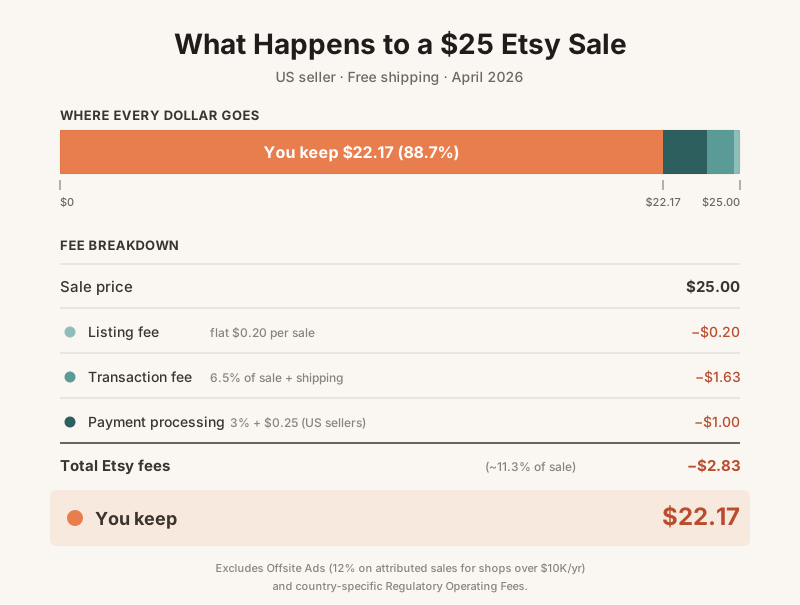
Before you can price anything, you need a clear-eyed view of what Etsy actually takes. As of April 2026, here's the fee stack for a US-based seller running a typical listing:
$0.20 listing fee when you publish a listing, plus another $0.20 every time the listing auto-renews after a sale.
6.5 percent transaction fee on the sale price, including any shipping you charge.
3 percent + $0.25 payment processing fee for US sellers using Etsy Payments. UK sellers pay 4 percent + £0.20. Most EU sellers pay 4 percent + €0.30.
12 percent Offsite Ads fee on attributed sales, but only if you've grossed more than $10,000 in the past 365 days or opted in voluntarily.
Country-specific Regulatory Operating Fees for sellers in the UK (0.32%), Canada (1.15%), India (0.29%), and a handful of other countries.
On a $25 order shipped free, a US seller keeps about $21.92 after Etsy takes roughly $3.08 in combined fees. That's about 12 percent. You can run this math by hand, use Etsy's own profit calculator or plug it into ListingView's Etsy Fee Calculator for a quick gut check. For the full fee policy details, see Etsy's Fees & Payments Policy.
How to Price Products on Etsy: The Fee-Aware Formula
To price products on Etsy profitably, use a fee-aware formula that works backward from your target profit: Target Price = (Cost of Goods + Labor + Desired Profit) ÷ (1 − 0.12). This backs into a number that covers Etsy's roughly 12 percent fee load and keeps your target profit intact, rather than hoping fees don't eat your margin.
The simpler version most Etsy guides teach is (Materials + Labor) × 2. It's fine as a rough starting point, but it ignores fees, which means the "profit" on your spreadsheet is really 10 to 12 percent smaller in reality.
Here's how each input works:
Cost of Goods is everything that physically goes into the product plus packaging. Buy materials in bulk? Calculate only the fraction you use per item.
Labor is your hourly rate multiplied by production time. Pay yourself at least your local minimum wage as a floor, and $20 to $30 per hour if you have real skill. This is where new sellers underprice the most.
Desired Profit is the dollar amount (not percentage) you want to clear per unit. Start with a number that feels worth your time.
Total Fee % is roughly 12% for US sellers. Bump this to 14% or 15% if you're enrolled in Offsite Ads, and higher for UK and EU sellers.
If your desired profit is $10 on an item that costs $6 in materials and takes 20 minutes of labor at $20/hour, the math is: (6 + 6.67 + 10) ÷ (1 − 0.12) = $25.76. Round to $25.99 and you've landed on a price that clears your profit target after Etsy's cut.
Example 1: Pricing a Handmade Soy Candle
Let's run through a realistic handmade example. You're selling a 9oz hand-poured soy candle.
Materials per unit: soy wax ($2.10) + wick, fragrance, dye ($1.40) + jar and lid ($2.80) + label and packaging ($0.90) + shipping supplies ($1.20) = $8.40
Labor: 15 minutes to pour, cure, and label = 0.25 hours × $25/hour = $6.25
Desired profit: $8 per candle
Running the formula: ($8.40 + $6.25 + $8) ÷ (1 − 0.12) = $25.74
You'd list this candle at $25.99 or $26.99. If the average top-selling candle in your subcategory sells for $32, you have room to raise to $29.99 and capture more margin. If similar candles are listing at $22, you may need to batch production to cut labor time or find a cheaper jar supplier.
You can check what comparable candles are priced at by manually scrolling Etsy search results and sorting by "Top Customer Reviews" or by using a product research database to filter by price and monthly sales volume.
Example 2: Pricing a Digital Printable
Digital products change the math because materials and shipping drop to nearly zero, but labor and market ceiling do most of the work. Say you're designing a printable wedding seating chart.
Materials per unit: $0 (it's digital)
Amortized costs: stock fonts or graphics licensing = $0.30 per sale
Labor: 4 hours of design at $30/hour = $120 one-time. If you reasonably expect 150 sales in year one, amortized labor is $0.80 per sale.
Desired profit: $6 per sale
Running the formula: ($0.30 + $0.80 + $6) ÷ (1 − 0.12) = $8.07
You could list this at $7.99 and still clear your target once you hit volume. Most wedding printables on Etsy sit between $6 and $15, so this is competitively priced.
The catch with digital products is that volume is everything, and volume depends on search ranking. Pricing aggressively doesn't help if your listing doesn't surface. Fixing the basics on your listings often matters more than price for digital goods.
Should You Include Shipping in the Price?
Etsy's search algorithm has favored listings with free shipping on US orders over $35 since the platform pushed the guarantee hard in 2019. That means if you price your item at $20 with $8 shipping, you're likely losing search visibility to a seller who lists at $28 with free shipping.
The simple test: add your typical shipping cost into the item price and see if it still feels competitive. If yes, go free shipping and let the buyer see one round total. If no (heavy or oversized items where shipping runs over $10), keep shipping separate and accept the visibility tradeoff.
One catch: the 6.5 percent transaction fee applies to shipping too, so baking shipping into the item price doesn't save you anything on fees. This is purely a search ranking and buyer-perception decision.
Pricing Psychology That Actually Works on Etsy
A handful of psychological pricing tactics are consistently supported by research, and they apply well to Etsy.
Charm pricing (ending in .99 or .95) makes prices feel meaningfully lower than the round number above them. This is the "left-digit effect": buyers anchor on the first digit, so $19.99 feels closer to $19 than $20. Research on charm pricing has shown lifts in conversion ranging from 24 to 60 percent, with the strongest results on discount and mid-range goods.
Price anchoring works when you list tiered options. A $35 small / $55 medium / $85 large lineup makes the medium feel like the sensible middle, which is usually where you want buyers to land. Many Etsy sellers quietly use variations to anchor toward the option with the best margin.
Prestige pricing (round numbers like $120 or $200) signals quality and works better for premium or bespoke items. A custom wedding invitation suite at $200 often outperforms the same thing at $199.99.
Pick the tactic that matches what your product actually is. A $12 printable should end in .99. A $250 hand-carved serving board probably shouldn't. For a deeper dive from Etsy itself, the Etsy Seller Handbook's pricing guide is a solid read.
When (and Why) to Raise Your Prices
New Etsy sellers almost always underprice, then resist raising prices because they're afraid of losing sales. A few signs it's time:
You're booked solid and can't keep up with orders. That's demand exceeding supply, which is a price signal.
Your cost of goods went up. Supplier price increases don't come out of your pocket. They come out of the buyer's.
Your profit margin is under 20 percent after all fees and labor. That's not a sustainable business. That's a hobby with receipts.
Competitors in your niche raised prices. Check the top sellers in your subcategory at least twice a year.
When you do raise, do it in a single clean step rather than creeping up a dollar at a time. Existing favorites and cart items often convert at the old price, which is a nice cushion during the transition.
How to Check Your Prices Against the Real Market
Your pricing math only works if there's a market at that price. Two ways to sanity-check:
Manual research. Search your top keyword on Etsy, sort by "Top Customer Reviews" (a rough proxy for bestsellers), and log the top 10 prices in a spreadsheet. This is free and takes about 20 minutes per niche.
Data-driven research. Tools like ListingView's product research database let you filter listings by monthly sales volume and price range, so you can see what prices are actually converting rather than just what's being listed. For deeper competitor breakdowns, analyze any Etsy shop's performance to see their full price distribution and best performers.
Either way, the goal is the same: find out what the top 10 to 20 percent of your niche charges, and aim to sit inside that range unless you have a clear reason to price above or below.
If your priced-correctly listings still aren't selling, the problem usually isn't price. It's keywords, photography, or listing quality. How Etsy's algorithm actually works in 2026 is a better starting point than another round of price-cutting.
Frequently Asked Questions
What is the best pricing formula for Etsy?
The most reliable formula backs into a price from your target profit: Target Price = (Cost of Goods + Labor + Desired Profit) ÷ (1 − Fee %). For US sellers, use 0.12 as the fee percentage to account for listing, transaction, and payment processing fees. This method guarantees you hit your profit goal even after Etsy's cut, rather than hoping a simple doubling of costs is enough.
What is a good profit margin on Etsy?
A healthy profit margin on Etsy is 20 to 40 percent after you subtract all fees, materials, and labor. Many successful shops target around 30 percent. Under 20 percent leaves little room for marketing, reinvestment, or slow months. Digital product shops can often hit 60 to 80 percent margins because materials cost nearly nothing beyond your initial design time.
Should I include shipping in my Etsy price?
Yes, for most items under a pound. Etsy's search algorithm favors listings with free shipping on US orders over $35, and buyers strongly prefer seeing one round total at checkout. Add your typical shipping cost into the item price and offer free shipping. For heavy or oversized items where shipping runs over $10, it's often better to keep shipping separate.
How much should I charge for labor on handmade items?
Pay yourself at least your local minimum wage as a floor, and $20 to $30 per hour if you have real skill or years of experience. Don't leave labor out of your price just because you enjoy making the product. Accurate labor cost is what separates a sustainable handmade business from a time-expensive hobby.
Does charm pricing still work on Etsy?
Yes, for items under about $50. Prices ending in .99 or .95 consistently convert better than round numbers at lower price points because buyers anchor on the first digit. For premium or luxury items over $100, round prices signal quality and often perform better. Match the tactic to what your buyer expects from that category.
Our team is consistently improving ListingView to provide better data, tools, and insights for Etsy sellers. Because of this, some features or screenshots mentioned in this post may look slightly different from what you see inside ListingView.