How to Write Etsy Descriptions That Actually Sell in 2026
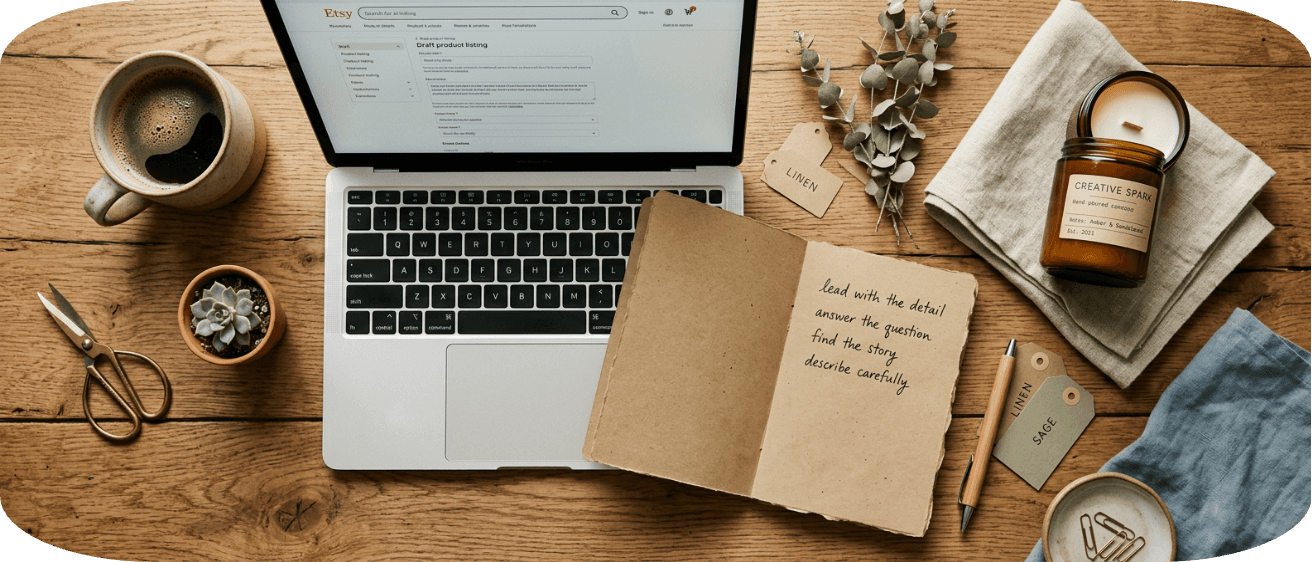
Most Etsy sellers treat the description box like a chore. They paste in a few sentences, list dimensions, and move on. That is a mistake, and it is costing them sales.
Knowing how to write Etsy descriptions well is one of the few listing skills that pays off twice. A good description answers the questions that make a buyer hesitate, and it feeds keywords to both Etsy search and Google. As of June 2026, Etsy's own Seller Handbook confirms that both offsite and Etsy search algorithms consider keywords and phrases in your listing descriptions when ranking. So this is not just copywriting. It is part of your Etsy SEO.
This guide walks you through what actually works now, with real structure you can copy.
How do you write a good Etsy description?
A good Etsy description leads with the single most important detail in the first sentence, answers the buyer's top three or four questions in plain language, and works your main keyword into the opening naturally. Format it with short paragraphs or bullets so a shopper can scan it on a phone in ten seconds.
That is the 60-second version. The rest of this post breaks down each piece, because the order you put information in matters more than most sellers realize.
Why your Etsy description matters more than you think
Here is the part that confuses people. For years the advice was "descriptions don't affect ranking, so don't bother." That was never fully true, and it is less true now.
Your description does two distinct jobs.
First, it drives conversion. A shopper who lands on your listing and cannot quickly find the size, the material, the turnaround time, or the return policy will leave. Etsy watches that behavior. When more visitors buy instead of bouncing, your conversion rate climbs, and conversion rate is one of the strongest quality signals in how Etsy's algorithm decides what to rank. A description that closes objections raises conversion, and higher conversion lifts your ranking over time.
Second, it feeds search directly. Etsy's Seller Handbook states that keywords in your description are considered by both Etsy and offsite search. And the first 160 characters of your description become the meta description that Google shows under your listing in its results, as Etsy explains in its SEO guidance for shop and listing pages. That snippet decides whether a Google searcher clicks your listing or scrolls past it.
So a weak description leaks sales in three places at once: lower conversion, weaker Etsy relevancy, and a dull Google snippet.
Lead with the most important detail in the first sentence
Open with a sentence that tells a shopper exactly what the item is, who it is for, and why it stands out. Do not warm up with "Welcome to my shop" or a paragraph about your creative journey. Save that for lower down.
Compare these two openings for a personalized leather journal.
Weak: "Thank you so much for visiting my little shop! I started making these because I love stationery."
Strong: "Personalized leather journal, hand-stitched in full-grain leather and embossed with up to 20 characters of your choice. A6 size, 192 unlined pages, ships in 3 to 5 business days."
The second version does three things at once. It tells the buyer what they are getting, it front-loads keywords like "personalized leather journal" and "full-grain leather," and it fills those critical first 160 characters that Google will display. A person can read the first sentence and know precisely what is for sale, which is exactly what Etsy recommends.
To know which keywords belong in that opening, look at the terms buyers actually type. You can check Etsy's search autocomplete by hand, review your own Shop Stats for the phrases already bringing you traffic, or use a keyword tool that shows real buyer search volume to compare demand and competition before you commit. Whatever method you use, write the opening for a human first and slot the keyword in where it reads naturally.
Answer every question a buyer might ask
Think of the body of your description as a pre-emptive FAQ. Every question a shopper has to email you about is a question that made them pause, and a paused shopper often does not come back.
Cover the basics for your product type:
What it is made of, and the exact dimensions or file specs.
How it ships, how long production takes, and what packaging looks like.
Personalization or customization options, and how the buyer sends you their details.
Care instructions, sizing guidance, or what is included in a digital download.
Your return, exchange, or revision policy in one clear line.
For a digital product, that last group changes. Spell out the file formats, the dimensions or DPI, how many files are included, whether the file is editable, and that nothing physical ships. Digital buyers return items at a higher rate when expectations are fuzzy, so clarity here protects your reviews.
A useful test: read your description as if you have never seen the product. If any obvious question is unanswered, add a line. This is the same discipline that prevents several of the listing errors that quietly drain sales.
Format so it can be read on a phone in ten seconds
More than half of Etsy traffic is mobile, and a wall of text is the fastest way to lose a mobile shopper. Etsy's guidance on the anatomy of a well-crafted listing is direct about this: use short paragraphs and bullet points, and cut superfluous language.
A structure that works well:
A one to two sentence hook at the top with the product and main keyword.
A short "What you get" or "Details" block, ideally as a bulleted list.
A "Shipping and processing" line.
A "Personalization" or "How to order" block if relevant.
A brief closing with your policies and a soft nudge to a related section of your shop.
That last move is underused. Etsy explicitly suggests linking from a description to a related section or complementary listing. If a buyer is not biting on this item, a link to your matching set or a different color can keep them in your shop instead of back in search.
Should you write Etsy descriptions in your own voice?
Yes. If you are a solo maker, write in the first person and let your personality show. Etsy's Seller Handbook notes that buyers love to connect with the person behind the product, and a human voice can be a genuine selling point.
The trick is balance. You want a sentence or two of brand voice that casually carries a few keywords, not three paragraphs of backstory before the buyer learns the size. Put the warmth near the end, after the practical details are handled. A short "Each piece is made to order in my home studio in Vermont, so slight variations are part of the charm" does more for trust than a long origin story up top.
Where ListingView fits into your description workflow
You can write strong descriptions with nothing but Etsy's own tools and a careful eye. Shop Stats shows your real search terms for free, and reading competitor listings by hand teaches you a lot about what buyers expect.
If you want to move faster, a few features help. Look up any listing to see its SEO score cards in Listing Explorer, which grade title, tags, photos, and description, so you can see how a top seller in your niche structures theirs. When you are editing your own connected shop, the AI Writing Assistant inside can optimize, shorten, or change the tone of a draft you have already written. Treat it as a co-writer, not an author. The strongest descriptions still come from a seller who knows the product and the buyer, then uses a tool to tighten the result.
A quick before-and-after
Before: "Handmade soy candle. 8 oz. Smells great. Made with love."
After: "Hand-poured soy candle in Sea Salt and Sage, a fresh, calming scent for living rooms and bathrooms. 8 oz amber glass jar, roughly 45 to 50 hours of burn time, cotton wick, no paraffin. Ships in 2 business days in protective, recyclable packaging. Want a matching set? See the full scent collection in my shop."
The after version is barely longer, but it names the scent and material for search, sets burn-time and shipping expectations, removes return-driving surprises, and ends with an internal link. That is the difference between a description that decorates a listing and one that earns the sale. For the full picture of how titles, tags, and descriptions work together, see the complete data-driven Etsy SEO guide.
Frequently asked questions
Do Etsy descriptions affect SEO?
Yes, in two ways. Etsy's Seller Handbook confirms that keywords in your description are considered by both Etsy and offsite search engines. Descriptions also drive conversion rate, a major Etsy ranking signal, and the first 160 characters become your Google meta description. So a strong description helps you rank on Etsy and earns more clicks from Google.
How long should an Etsy description be?
There is no fixed length, but most effective descriptions run 150 to 400 words. Lead with the key detail in the first sentence, cover every question a buyer might ask, and stop once you have. Length matters less than order and clarity. A scannable 200-word description usually outperforms a rambling 600-word one.
Should I put keywords in my Etsy description?
Yes, but naturally. Work your main keyword into the first one or two sentences, since that text feeds both Etsy search and your Google snippet, then use related phrases where they fit. Do not stuff a keyword list at the bottom. Awkward repetition reads as spam to buyers and does not help your ranking.
What should the first sentence of an Etsy description say?
The first sentence should state exactly what the item is, who it is for, and its standout feature, while including your main keyword. A shopper should know precisely what you are selling from that one line. It also fills the first 160 characters Google displays, so make it specific and benefit-led rather than a generic welcome.
How do I write descriptions for digital products on Etsy?
Spell out the file formats, dimensions or DPI, the number of files included, and whether the file is editable or print-ready. State clearly that the product is a digital download and nothing physical ships. Add any usage terms. Clear expectations reduce confused buyers and protect your reviews, which matters more for digital items.
Our team is consistently improving ListingView to provide better data, tools, and insights for Etsy sellers. Because of this, some features or screenshots mentioned in this post may look slightly different from what you see inside ListingView.