How to Spy on Your Etsy Competitors

Every successful Etsy seller pays attention to what other shops in their niche are doing. Not to copy them, but to learn from them. Understanding how your competitors price their products, structure their listings, and attract buyers gives you a real advantage when it comes to positioning your own shop.
The good news is that Etsy is an incredibly transparent marketplace. Most of the information you need is publicly available. You just need to know where to look and what to pay attention to.
In this guide, we'll walk through how to analyze your Etsy competitors in a way that's strategic, efficient, and completely above board. No shady tactics required.
Why Competitor Research Matters
A lot of new sellers skip competitor research because it feels uncomfortable. They worry that looking at other shops means they'll end up copying someone, or they feel discouraged seeing how far ahead other sellers are. Both reactions are understandable, but they miss the point.
Competitor research isn't about imitation. It's about context. If you don't know what buyers in your niche are already seeing when they search on Etsy, you can't make informed decisions about how to stand out. You might price too high or too low without realizing it. You might use photos that blend in with everyone else. You might miss a product variation that buyers clearly want but nobody is offering well.
Studying your competitors helps you understand what the baseline looks like in your market so you can aim above it.
Step 1: Identify Who Your Competitors Actually Are
Your competitors aren't every shop on Etsy. They're the shops that show up when a buyer searches for the same type of product you sell.
To find them, search for your main product keywords on Etsy in an incognito window. The shops that consistently appear in the top results for your core keywords are your direct competitors. These are the sellers your potential buyers are comparing you to, whether you realize it or not.
Make a short list of five to ten shops. You don't need more than that. Focus on a mix of top performers (shops with thousands of sales) and mid-range sellers (shops with a few hundred sales). The top performers show you what's possible. The mid-range sellers show you what's realistic and often reveal strategies that are more applicable to where you are right now.
Step 2: Look at Their Best-Selling Listings
Once you have your list, the next step is figuring out which of their products are actually driving sales. Most shops have a mix of strong performers and listings that don't do much. You want to focus your attention on the winners.
There are a couple of ways to spot a shop's best sellers. On Etsy, you can sort a shop's listings by "Top Customer Reviews" which gives you a rough idea of what's popular. Listings with the "Bestseller" badge are another obvious signal.
If you want a faster and more data-driven approach, ListingView's Shops tool lets you search for any Etsy shop and see a breakdown of their listing performance. You can see which products are generating the most sales without having to click through every listing manually. It turns what would normally be an hour of detective work into a couple of minutes.
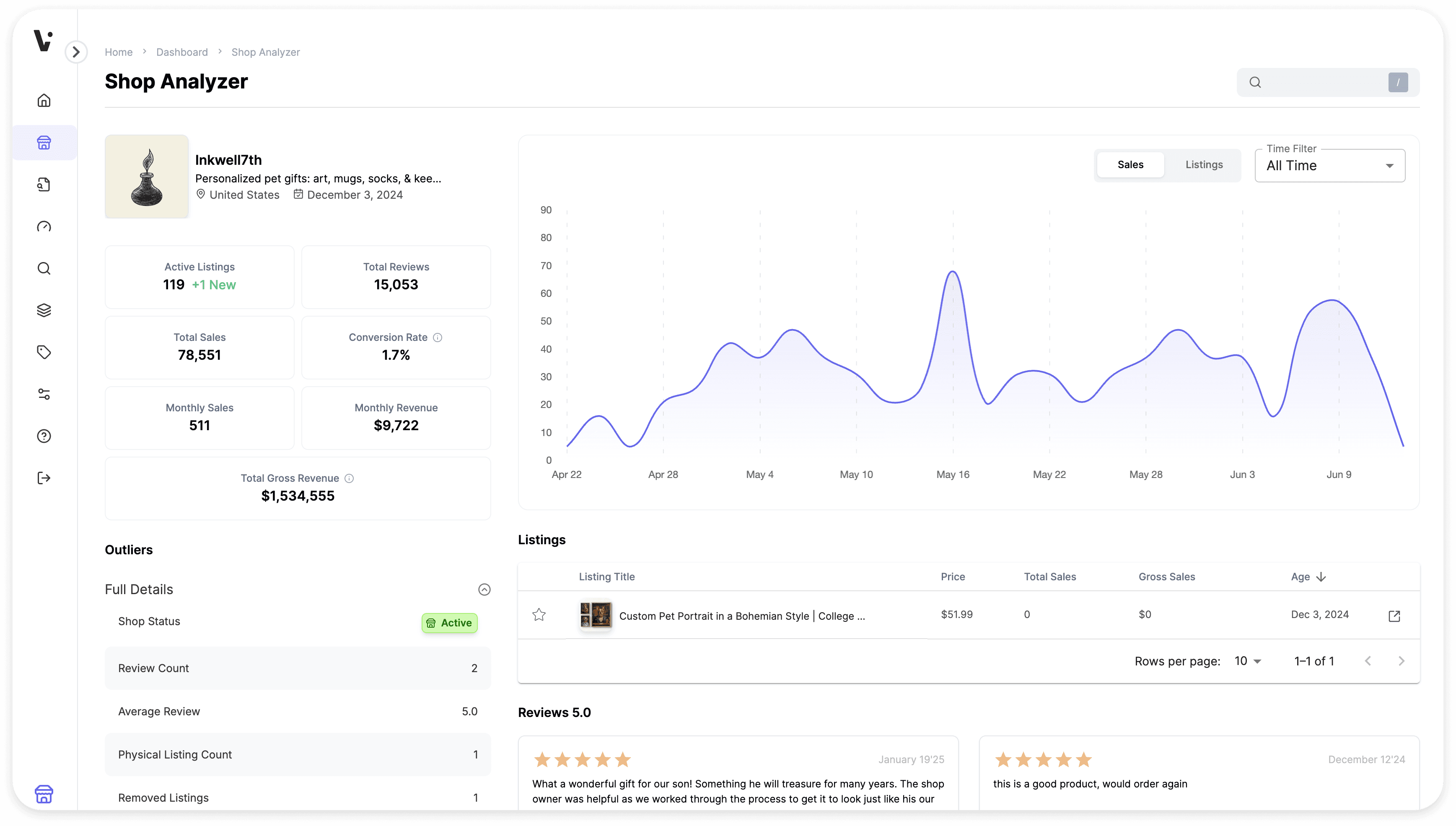
Once you've identified their top sellers, take note of a few things. What type of product is it? What price point are they using? How many variations do they offer? Is it personalized? These details start to paint a picture of what's working in your niche.
Step 3: Study Their Titles and Tags
How your competitors write their listing titles tells you a lot about their SEO strategy and who they're trying to reach.
Look at the structure of their titles. In 2026, Etsy suggests using natural, readable titles under 15 words. If a competitor is still using keyword-stuffed titles like "Dog Bandana Pet Bandana Puppy Bandana Custom Dog Scarf Pet Accessory," that's actually an opportunity for you. A cleaner, more descriptive title will likely perform better under the current algorithm.
Pay attention to the specific words they use. If multiple top sellers in your niche all include a certain phrase in their titles, that's a strong signal that buyers are searching for that term. You don't need to use the exact same title, but you should be aware of which keywords matter in your space.
For tags, you can't see a competitor's tags directly on Etsy. But ListingView's Tag Extractor lets you pull the tags from any Etsy listing. This is incredibly useful because it shows you which keywords a seller is targeting behind the scenes. You can use this to discover keyword angles you might not have considered.
Step 4: Analyze Their Photos and Branding
Photos are often the biggest differentiator between shops selling similar products. Two sellers can offer nearly identical items, but the one with stronger photos will almost always win the click.
When looking at a competitor's photos, ask yourself a few questions. Are they using lifestyle images that show the product in context, or just plain mockups on a white background? Do their images communicate scale and size? Is there a consistent visual style across their shop? Do they use infographics or text overlays to highlight features?
Also look at how many photos they include per listing. Etsy allows up to 20 images and a video. Sellers who use at least 8 of those slots tend to convert better because buyers have fewer unanswered questions before they purchase.
You're not trying to replicate their photos. You're trying to understand the visual standard in your niche so you can meet or exceed it.
Step 5: Read Their Reviews
This is one of the most valuable and most overlooked parts of competitor research. A competitor's reviews are essentially free market research, written by the exact customers you're trying to attract.
Start with the positive reviews. Look for patterns in what buyers praise. Do they mention fast shipping? Beautiful packaging? Better quality than expected? These patterns tell you what matters most to customers in your niche. Make sure your shop delivers on those same things.
Then read the negative reviews. These are where the real opportunities hide. If multiple customers across different shops complain about the same issue, like slow processing times, unclear sizing, or colors that don't match the photos, that's a gap you can fill. Solving a problem that your competitors consistently fail at is one of the fastest ways to build a strong reputation in a competitive niche.
Step 6: Check Their Pricing Strategy
Pricing is one of the first things buyers compare when deciding between similar products. Understanding how your competitors price their items helps you position yourself intentionally rather than guessing.
Look at the price range across your competitor list. Is there a cluster of shops around a certain price point? Is anyone charging significantly more or less than the average? If a shop charges more and still generates strong sales, look at what justifies the premium. It might be personalization, faster shipping, better packaging, or simply stronger branding.
Don't assume you need to be the cheapest option. Competing on price alone is a losing strategy on Etsy because there will always be someone willing to go lower. Instead, focus on offering clear value at a price that supports healthy margins. Buyers on Etsy are generally willing to pay more for products that feel thoughtful, well-made, and unique.
Step 7: Look at Their Shop as a Whole
Finally, zoom out and look at each competitor's shop as a complete experience. Visit their shop page and notice how it feels. Is their banner professional? Does their "About" section tell a compelling story? Are their shop sections organized in a way that makes it easy to browse? Do their policies feel clear and trustworthy?
These details might seem minor, but they all contribute to whether a buyer feels confident purchasing from a shop. A well-organized, professional-looking shop builds trust. A messy or incomplete one creates doubt, even if the products themselves are great.
Take note of what your competitors do well in these areas, and also notice where they fall short. Every weakness you spot is a chance to do something better.
Turning Research into Action
Competitor research only matters if you actually use what you learn. After going through the steps above, you should have a clear picture of the landscape in your niche: what products are selling, how they're priced, what the photos look like, which keywords matter, and where the current sellers are leaving room for improvement.
Use that information to make specific decisions about your own shop. Maybe you adjust your pricing to be more competitive. Maybe you invest in better photos. Maybe you add a product variation that buyers are clearly asking for but nobody is offering well. Maybe you rewrite your titles to be cleaner and more targeted than what's currently ranking.
The sellers who grow consistently on Etsy aren't the ones with the most creative ideas. They're the ones who understand their market deeply and make smart, informed decisions based on what they see. Competitor research is how you build that understanding.
Our team is consistently improving ListingView to provide better data, tools, and insights for Etsy sellers. Because of this, some features or screenshots mentioned in this post may look slightly different from what you see inside ListingView.